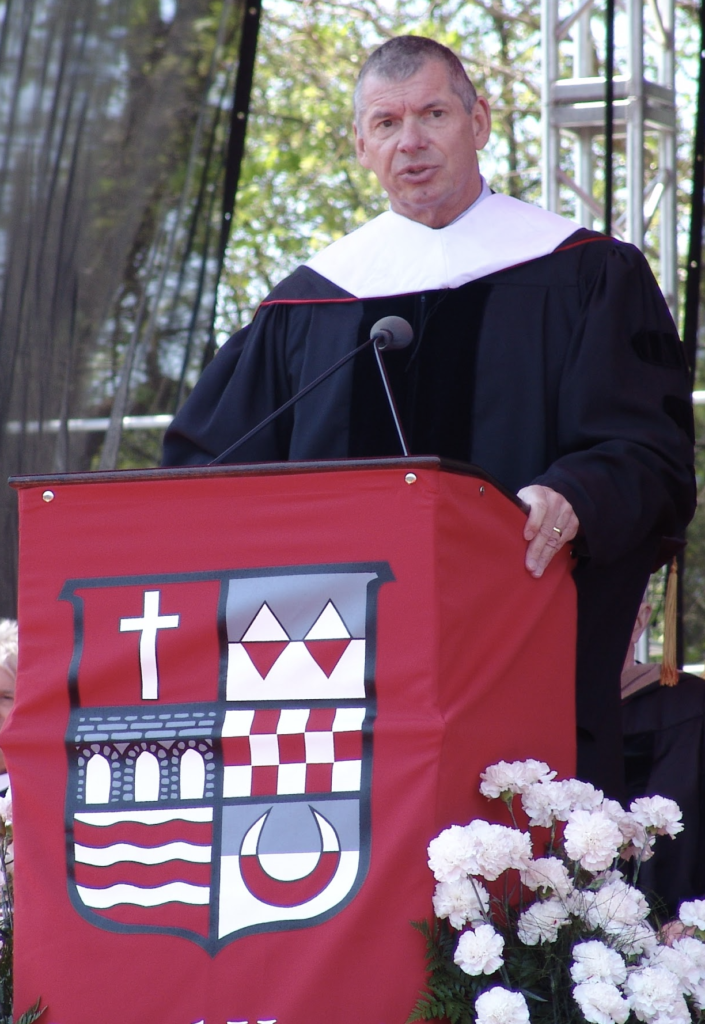
Dr. Mary Kate Holman, a professor at Fairfield University, came to Sacred Heart University to host “Chipping Away at the Stained Glass Ceiling” on Feb. 11, in the Michelle C. Loris Forum.

Source: Jamie Van Der Merwe, Staff Writer and Photographer
The colloquium primarily focused on the barriers women encountered at the second Vatican council and on the role they played in shaping the policies instated there.
“I think that history, especially recent history, is really important for understanding where we are now,” said Holman.
She wanted the discussion to draw on history and theology in order to reflect on present day questions.
In addition to teaching, Holman has also written a book, entitled Marie-Dominique Chenu: Catholic Theology for a Changing World. She also researches feminist ecclesiology as a way of looking at the divide between what the Catholic Church is and what it could be through the specific lens of patriarchal issues.
“It usually starts from things that bother me or things I’m curious about,” said Holman. “For the last five or ten years, this idea that history can help us understand the present has been important for me.”
“I do not know Dr. Holman personally, but I do know about the important theological work she is doing, trying to address the many social and doctrinal issues confronting a post-post Vatican II Church,” said Dr. June-Ann Greeley, a professor of English and practicing Catholic.
Holman got her start in the field when she was an undergraduate. Having taken several theology courses, she had to reconcile what she learned with her experience having been raised a Catholic.
“I was trying to make sense of how the Church was both the place where I was the most spiritually anchored, but also as a woman, it was the place where the thing my parents told me, ‘you can be whatever you want to be when you grow up,’ wasn’t actually true,” said Holman.
Historically, near the beginning of the Church’s life, women had very prominent roles, acting as deacons and leaders. However, this changed in the fifth century.
“The role of the female diaconate was discontinued by an all-male Council, and that coincided with an increasingly patriarchal tone among the male leaders and within the treatises of the male theologians,” said Greeley.
Holman also discussed how several woman-led organizations are pushing for change within the Church. Additionally, she mentioned how women have obtained more representation, having the right to sit in and vote in the Synod of Bishops.
Junior Grace Baranosky did not know much about Vatican II before the colloquium, nor did she know about women’s role in the council.
“As a woman member of the Church, it’s great to hear that people care about this and that it’s a conversation that’s happening,” said Baranosky.
As for sophomore Jenna Massaro, she found the colloquium eye opening.
“I talked to the speaker afterwards and she showed me a conference that is kind of similar to this stuff, so I might attend that and further my knowledge,” said Massaro.
Holman is hopeful for the future of the Church.
“At its best, it could be a community of people who are all journeying together to get closer to God,” said Holman.