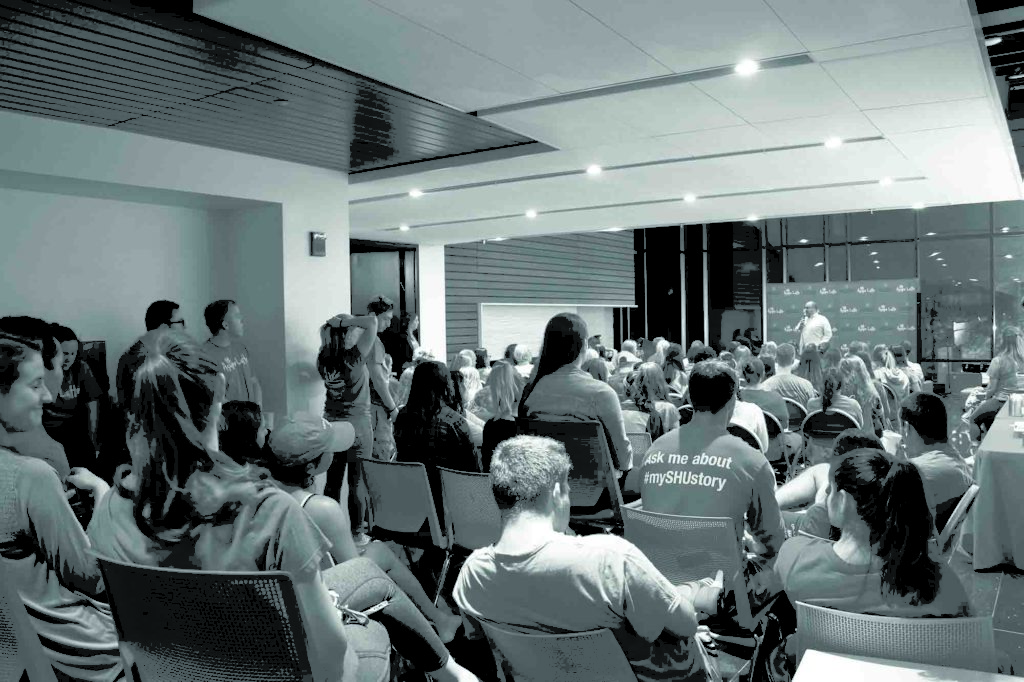
Have you ever touched a human brain? Students who attended Sacred Heart University’s Human Anatomy Cadaver Lab open house got the opportunity to do just that.
The lab was held on March 19 from 7 p.m. to 9 p.m. in the Human Anatomy Lab at the Center for Healthcare Education (CHE).
The event was organized through a collaboration between Prof. Peter Ronai, the Exercise Science Club and the Pre-Health Community Honors Club. They invited undergraduate students from a variety of health-related majors to explore human anatomy through direct, guided interaction with human cadavers.
Students, both from Sacred Heart and other universities, were able to go freely through the lab and engage in tableside learning alongside professors, graduate assistants, and practicing clinicians.
To guide students through the experience, there were interactive prompts and scavenger hunt activities that encouraged participants to identify specific structures.
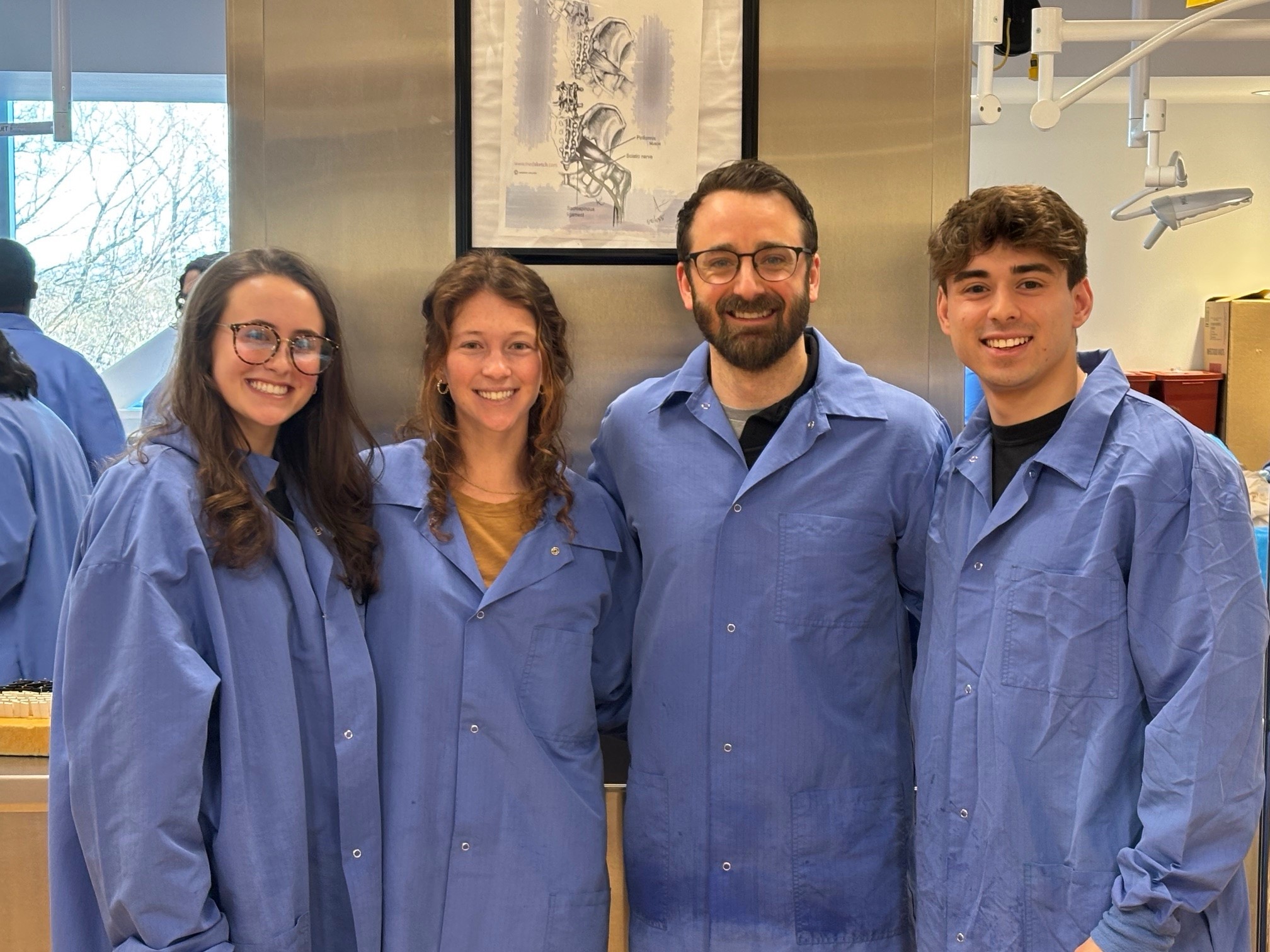
Contributed by Professor Andrew Sullivan
Ronai, clinical professor of exercise science and Exercise Science Club advisor, said the goal was to create an environment where students felt comfortable actively participating.
“I welcome them and explain what they are going to see in there, and I encourage them to ask questions and touch,” said Ronai.
The lab featured six human cadavers that were prepared for educational use, three facing up and three facing down, allowing students to explore both anterior and posterior structures of the body.
Students were able to examine a huge range of parts of the body throughout the lab, helping them better understand how everything is connected.
Dr. Andrew Sullivan, assistant clinical professor and director of the Human Anatomy Lab, helped facilitate the event by preparing the cadavers and guiding students throughout the lab.
“I’ve worked closely with Prof. Ronai to give undergraduate students the opportunity to see the lab and get the experience,” said Sullivan. “We want to generate interest and get students used to being in a lab like this, while also giving them the opportunity to interact with the larger health community.”
While they looked at structures like the rotator cuff, hamstrings and abdominal muscles, as well as the spinal cord, sciatic nerve, heart, lungs and even the brain, these were only a small portion of what was available. Students had the opportunity to see and touch many different muscles, organs and systems throughout the body.
Students also had the opportunity to explore the Anatomage room, which features a high-tech, life-sized touch screen virtual dissection platform that is used for 3D anatomy.
Unlike traditional classrooms, the lab emphasized hands-on learning. Students wore gowns and gloves, allowing them to directly interact with muscles, joints, nerves and organs.
For Ronai, this type of experience helps students better understand the human body in a meaningful way.
“Once you see what is under the skin, it can inform your decisions of what to do with people,” said Ronai. “It makes it less frightening and intimidating.”
While Sacred Heart offers resources such as digital cadaver tables and anatomical models, Sullivan emphasized that combining these tools with cadaver work creates a more complete understanding of how the body functions.
“The main difference is seeing what it looks like in real life. Digital models don’t give you an appreciation of how everything is truly connected,” said Ronai.
Senior Shea Rhodes, president of Exercise Science Club, who is on the physical therapy track and staying at Sacred Heart for physical therapy school, saw strong student engagement throughout the night.
“Nothing in a textbook can prepare you for it. A lot of us were excited to go into it because we knew we would be there a lot next semester,” said Rhodes. “A lot of schools don’t have this. It’s so nice Prof. Ronai cares about students getting experience in the cadaver lab outside the classroom.”
Aidan Glennon, a graduate assistant for the Doctor of Physical Therapy program, helped guide students during the event, reflecting on the impact of the experience.
“The students were great. They arrived well-prepared and engaged, asking thoughtful questions throughout the experience,” said Glennon. “Their genuine enthusiasm for the material created a positive, dynamic atmosphere that really shaped the success of the evening.”