Students, faculty and staff gathered in the Pierre Toussaint Hall lobby on March 25 for the 9th annual Hunger Project. The event, held during Social Justice Week, focused on a hands-on effort to package meals for local communities.
Source: Sacred Heart University
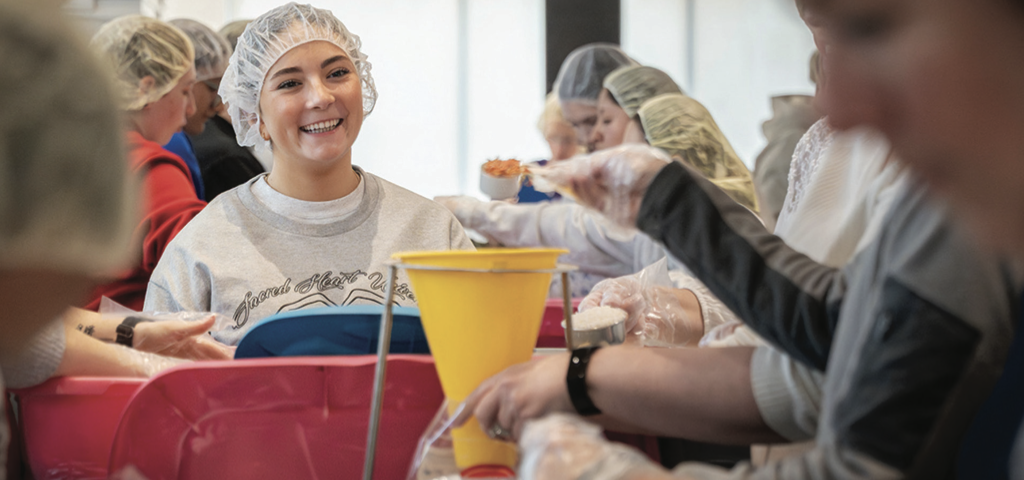
Volunteers worked in groups at long tables, assembling red lentil jambalaya meals through a coordinated process. Each person had a role, creating an organized system that allowed thousands of meals to be completed in just a few hours.
“For the US Hunger Project, 136 volunteers came together to pack 20,070 meals,” said Andrés Torres Alvarez, coordinator of Community Partnerships. “Events like this bring people together, allowing them to make an immediate impact while also raising awareness about food insecurity in the community.”
The event is organized through partnerships between Sacred Heart and organizations like U.S. Hunger, which helps design and run the meal packaging events. Funding for the event comes from donations, fundraising efforts and university support, helping cover the cost of ingredients and supplies used during the packaging process.
Each table operated like its own system, with volunteers rotating between scooping ingredients, sealing bags and checking measurements. The constant movement kept the pace steady and required everyone to stay engaged.
“I took on multiple roles during the process,” said senior Paris Sonnenberg. “First I started with holding the bag as everyone dumped the food in, then I switched to adding salt and weighing the bag to make sure it had the right amount.”
As meals were completed, boxes quickly filled and were prepared to be moved out of the lobby. Volunteers worked together to keep the process moving from table to table.
After the event, the meals are transported to community organizations that distribute food to individuals and families throughout the Bridgeport area.
“These meals were donated to our local partner, nOURish Bridgeport, to support its food pantry,” said Torres Alvarez.
Inside the room, students described a high-energy atmosphere as groups worked toward completing their boxes. The fast pace and teamwork created a sense of shared motivation among volunteers.
Rather than working individually, students relied on each other to keep the process moving efficiently. This made the experience feel more interactive and engaging.
“The room was buzzing, everyone was super excited,” said Sonnenberg. “My table took on a competitive vibe and was moving as fast as possible to get our boxes done before other tables.”
Students said the event stood out because of how active and involved it felt from start to finish. Every role contributed directly to the outcome, making the experience feel more meaningful.
The hands-on structure allowed participants to see the impact of their work in real time as boxes continued to stack throughout the event.
“It was really high-energy and hands-on, and it felt like everyone was working toward the same goal,” said Arlete Perez, assistant director of Community Engagement.
Students also reflected on the personal impact of participating in the event. Many connected the experience to their own interests and future goals.
The opportunity to contribute in a direct way made the event feel more significant beyond just volunteering.
“This event was especially important for me because I am a dietetics and nutrition concentration, so I know the harmful effects of starvation and not meeting nutrition needs,” said Sonnenberg.
The event began with opening remarks that set the tone before volunteers started working. This moment helped give context to the purpose behind the event.
Students said that message stayed with them as they moved through the process and contributed to the overall energy in the room.
“The moment that stuck out the most to me was Reverend Sara’s speech at the beginning,” said Sonnenberg. “She lit a fire in everyone in the room by adding motivation and passion.”
For some students, the experience also provided a clearer understanding of how large-scale food efforts operate. Seeing the process come together made the impact feel more tangible.
The scale of the event and the number of meals produced gave students a new perspective on how many people are involved behind the scenes.
“I genuinely believe that people should take part in this because you are not only helping the community that truly needs it but also working together to create a meal,” said senior Alina Rodriguez.